
While spotlights illuminate dresses reimagined with Taekwondo belts on the Milan Fashion Week runways, in a production workshop in Linqi County, Weifang, Shandong Province, intelligent cutting machines are precisely cutting fabric for the next generation of competitive Taekwondo uniforms. This parallel montage spanning the fashion capital and the manufacturing town perfectly outlines a new landscape for the Taekwondo uniform industry in 2026: on one hand, luxury brands’ adoration of its core spirit; on the other hand, a profound transformation of the industrial chain from manufacturing to intelligent manufacturing.
A Taekwondo Tribute in the Fashion World: When Martial Arts Philosophy Meets Haute Couture
In September 2025, coinciding with the brand’s upcoming 50th anniversary celebration, German luxury brand MCM propelled Taekwondo into the center of fashion world attention with a grand show titled “The Art of Movement” at Milan Fashion Week. In this season’s designs, MCM Chief Creative Officer Dirk drew inspiration from the “movement” and “balance” of Taekwondo, deconstructing and recombining iconic elements of the uniform: the wide Taekwondo belt transformed into a sleeveless dress with three-dimensional pleats, a bright blue knot became the visual focal point of a mini jumpsuit, while a suit consisting of a vest, a crisp shirt, and pleated harem trousers perfectly embodied the “stillness” and tactical precision unique to martial arts.
“We explored the multidimensional meaning of ‘movement’—not only physical movement, but also the flow of culture and emotion,” Dirk stated after the show. The exhibition space was designed as an immersive dojo, even incorporating holographic projections generated by artificial intelligence, aiming to explore how movement shapes identity through the discipline and continuity of martial arts. This is not merely an appropriation of Eastern martial arts aesthetics, but a solemn tribute to the spirit of Taekwondo within the context of luxury.
A Technological Revolution in the Arena: From “Loose Robes” to “A Second Skin”
If the runway performances represent a metaphysical externalization of the spirit, then the real changes happening on the field are a battle of hardcore technology. Continuing the momentum from the end of 2025, 2026 witnessed a “tight-fitting revolution” in competitive Taekwondo uniforms.
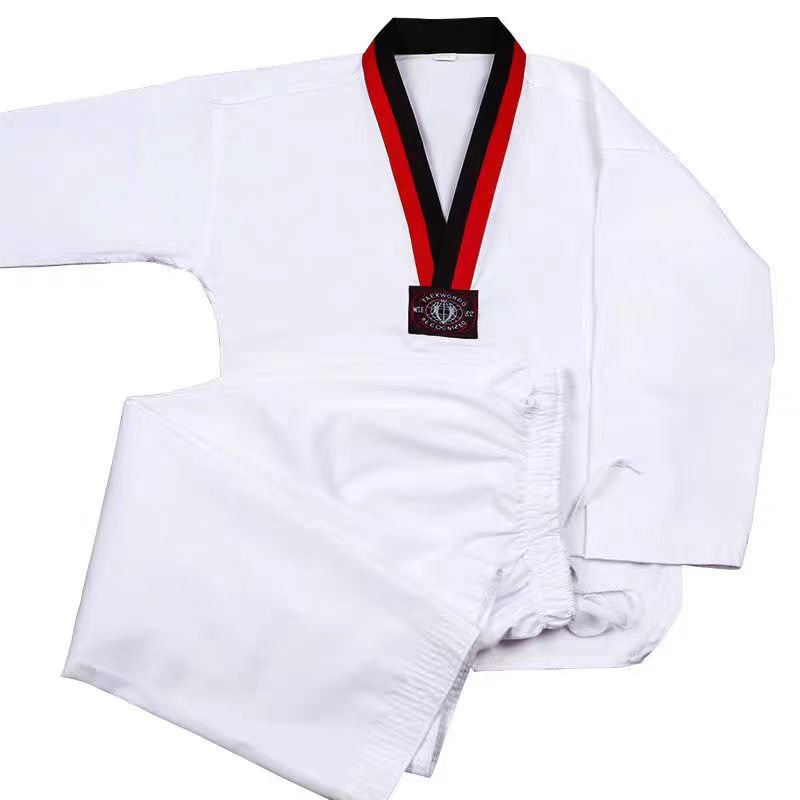
The traditional image of a loose, white “robe” is being overturned by a new type of tight-fitting elastic uniform called DEDOO. This equipment, certified by the World Taekwondo Federation, uses a special fabric composed of high-elasticity and high-strength fibers. It not only conforms better to the body’s curves to reduce air resistance, but its excellent stretch recovery also allows athletes to move more smoothly and freely during rapid turns and continuous attacks. More importantly, this close-fitting design improves heat conduction efficiency, helping athletes better regulate their body temperature during intense combat. The uniform is evolving from a simple “clothing” into an extension of the athlete’s body—a “second skin” in a competitive sense.
Meanwhile, the pace of market standardization has not stopped. The Singapore Taekwondo Federation released its list of certified uniform brands for the period from November 2025 to October 2026. International brands such as Kwon, Mooto, Daedo, and Adidas continue to be included, while contract changes for brands like Fila have created a new adjustment period for distributors. This reminds us that regardless of design iterations, official certification and quality standards remain the cornerstone of this industry.
Intelligent Manufacturing Breakthrough in the Supply Chain: The “Hidden Champion” of a Shandong County
Behind the glamour of fashion and competition, supporting this white uniform are busy production lines. In Xinzai Street, Linqu County, Weifang, Shandong, a “intelligent manufacturing breakthrough” in the sports industry is unfolding.
“Previously, we only made uniforms; customers had to find other companies to match their equipment. Now, from design and production to after-sales service, the entire chain is handled in one go,” said the production manager of Shangwu Sporting Goods Co., Ltd., pointing to the bustling workshop. This company has transformed itself from a single manufacturer of Taekwondo uniforms to a full-category enterprise in just ten years. Its products not only occupy more than 50% of the domestic professional Taekwondo uniform market but are also exported to 11 countries and regions.
Even more noteworthy is their future strategy. The company has invested millions of yuan in intelligent production lines and expects to soon offer “personalized customization” services—customers can submit size and pattern requirements online and receive their customized equipment within 72 hours. Furthermore, smart protective gear with sports data monitoring capabilities is already under development. Meanwhile, nearby Shiteng Sports has taken a “small but exquisite” approach. Its professional boxing gloves undergo more than ten pressure tests, and last year alone, it supplied over 100,000 pairs to suppliers for European and American events.
From traditional manufacturing to intelligent upgrades, from single-product production to a full-chain layout, these county-level enterprises are emerging as “hidden champions,” weaving the battle robes for Taekwondo enthusiasts worldwide.
The Glamour of Youth on the Field: A Two-Way Collaboration Between Brands and Events
At the end of the industry chain, young people are wearing equipment that embodies technology and hard work, sweating it out on the field.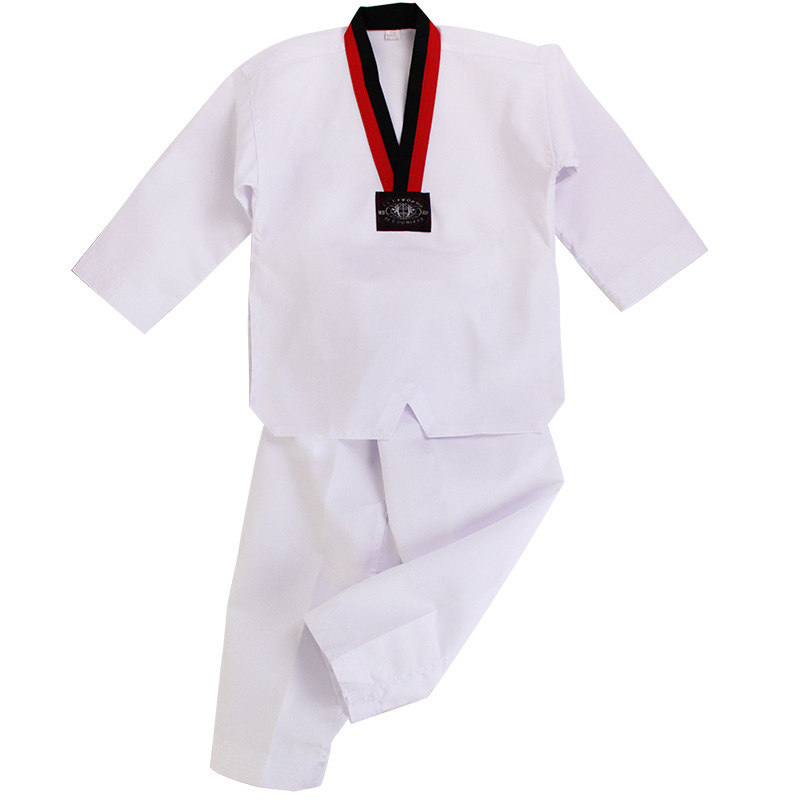
In August 2025, the “Anta Cup” 2025 Taekwondo Grand Slam World Youth Club League Finals were held in Chengdu, with over 2,000 young athletes from nearly 20 countries and regions competing. Anta Kids not only sponsored the event but also provided customized uniforms and professional competition bags. Behind this lies the brand’s profound consideration: currently, there are over 1 million active Taekwondo practitioners in China, with youth making up a significant proportion. The “one young athlete + 2 to 4 parents” participation model further extends the brand’s reach to a broad range of family consumption scenarios.
In Xi’an, the Shaanxi Provincial Boxing and Taekwondo Sports Management Center, through government procurement, equipped its professional teams with specialized competition uniforms from brands like Anta, ensuring athletes are well-equipped for the highest level of competition.
Even the market’s pursuit of quality has reached down to the finer details of fabric texture. In early 2026, students at a Beijing taekwondo school discovered a hidden anti-counterfeiting pattern on the cuffs of their newly issued uniforms, revealing the brand name under light. This application of anti-counterfeiting fabric, originating from South Korea, was not only for anti-counterfeiting purposes but also highly sought after by experienced practitioners due to its excellent drape and non-clumping properties.
From the Milan runway to the workshops in Linqi, from the competition venues in Chengdu to the taekwondo schools in Beijing, the 2026 taekwondo uniform has long transcended the realm of simple sports equipment. It represents MCM’s fashion philosophy, DEDOO’s technological fabric, Shangwu Sports’ intelligent cutting bed, and a badge of honor on the chests of young people. As the spirit of “movement” extends from martial arts schools to the global industrial chain, this white uniform is writing a new definition for this era.
Post time: Mar-20-2026